Thursday, January 1, 2015

The Genealogy Do-Over Part 2– Analyze

Back in December, Thomas MacEntee announced the Genealogy Do-Over. Since then the big red button above has been popping up all over! There is also a related Facebook group that has generated a ton of good ideas.

I decided to join in for a couple of reasons so I will have a post outlining a goal for each of those reasons.

Today – it’s all about analyzing!

Many people who are participating in the Genealogy Do-Over mention the regret of not documenting where they found information, especially back when they were getting started. When I look back at my very first visit to a courthouse - my first real research - I have very nicely written on each page where I got the information, book, volume, page.  I think I did a pretty good job because there is enough information there to allow me to craft a source citation.

My problem is not so much with that very early research, but with what I do (or don't do) once I have information. I am so thrilled with finding things that I don't stop, take a deep breath, and analyze what the information is telling me.  I don't spend time correlating things.  Pieces of information tend to live in isolation in my mind because I'm rushing on down the trail to the next piece of information.

Here are two posts pointing out rather embarrassing oversights on my part.  The first is a Tombstone Tuesday post which shows how I discovered that my great-great-grandmother did NOT die in Colorado.  The second post is a record of my discovery of information contained in a divorce file - a file that I had in my possession.  The piece of information was a huge break though in tracing a line I felt was a dead-end.  This was information I had all along but had overlooked because, at the time, I was looking for something else in that file.

I need to slow down as one of Thomas's recent posts suggest.  If I only have people back through my grandparent's generation when we get to the end of week 13, I'm OK with that.  I want to take time - not just to do this correctly, but to really THINK about what I have and what it means.

This is a real issue for me. When I first received the divorce file it enabled me to finally find my great-grandmother in the 1910 census.  I was then able to track her through 1920 and 1930 with different husbands in each.  That lead me to other marriage and divorce records.  But I never really read that first file and thought about EVERYTHING it was telling me.  I just pulled out a fact or two that I needed and I was off to the races. 

The Goal: Spend time as I add people to my new database to truly analyze the data. "Analyze" has many synonyms including:examine, study, investigate, scrutinize, evaluate, consider, question, and explore.  I need to think about all of those as I analyze my data.

This also includes understanding the time period and place these people occupied.  I need to do more reading.  It's great that Wayne County, Ohio birth records are online, but all the pages I download will not tell me as much as reading "Sonnenberg, a Haven and a Heritage", a history of the early settlement of the area in Wayne County where my ancestors lived. 

Time: Ongoing, but since I've decided that screen time right before I sleep is not good, I'll commit to devoting the last 30 minutes of my day to genealogy reading.


Tuesday, December 30, 2014

The Genealogy Do-Over Part 1 – The Software Dilemma


Back in December, Thomas MacEntee announced the Genealogy Do-Over. Since then the big red button above has been popping up all over! There is also a related Facebook group that has generated a ton of good ideas.

I decided to join in for a couple of reasons so I will have a post outlining a goal for each of those reasons.

Today – it’s all about the software! 

The Genealogy Do-Over comes at a great time for me because my database of choice, The Master Genealogist, is no longer supported as of 01 Jan 2015. Yes, I realize that I can continue to use it – probably for years and years. However I prefer to be pro-active and make a new choice while my old database is still viable. So, as part of the Do-Over, I will be starting two new databases from scratch…one in RootsMagic and one in Legacy. I will work in both databases up to, and including, my 4 grandparents. That should give me enough experience to decide which one to keep especially since, for me, this mean siblings and families in each generation.

Here are a few of my issues. The first is color – I love it! In TMG I used it extensively to keep track of the various Zaugg families I had - all descendants of Jakob Zaugg and Anna Stetler. I assigned each of the children a different color and all that child’s descendants (including spouses and children’s spouses) were assigned that color. When I had a great working chart done by Family ChartMasters I had it done in colors to match my database pictured below:


In RootsMagic I can almost approximate that, but there are not enough colors and some of them are ugly! I can’t seem to change them. Also, I can only find a way to color the text not the background. Sometimes that just doesn't stand out enough for me.  I'm still exploring all the ins and outs of the color schemes.

In Legacy it seems I can only assign color going in one direction – I can pick a person and go back their direct line but I can’t pick a person and all their descendants and go forward. I like the fact that Legacy used the background for the color, and also that I can set the colors to be what I want.  What I don't like is that those colors don't seem to "stick" - so when I am looking at the index of names, NO COLORS.

Overall I’m not in love with the options in either software.

The next issue is best put in a picture. This is part of the main screen for my maternal grandfather (in TMG): As you can easily see, he has three children. The issues is that those children did not all have the same mother. In my mind that shouldn’t matter – those are all his children and when I am working on a person I want to see all their children.

In Legacy I’ve been able to do that with the half-siblings option. In Roots Magic I haven’t found a way to view those children without flipping back and forth between spouses.

Finally there is the matter of a timeline. There are approximately a billion posts/webinars/sessions on how to create timelines and how important they are. I totally agree. The thing is I never really worried about creating one because my main “page” for any person in TMG IS a timeline. I can easily see what census info I have (or don’t have) and what events I’ve chosen to document for that person and, by extension, what events I haven’t yet documented.

Both Roots Magic and Legacy have an option to click on a tab and display a timeline. I like the feature in both although I don’t like that it’s a separate "thing" but it’s OK.

One thing I need to do is stop looking at my TMG database and just work in RootsMagic and Legacy during this Do-Over so I can be sure I'm exploring the cool things they can do that possibly I've never considered in my current database.  One of those things is DNA.  I've just gotten started in this area and I want a database that can document this new information.

I should say that what I’ve written here is based on my dumping a GEDCOM into each program when I was doing my Zaugg tracking and then just trying out a few things. I have not yet explored in any depth what is available in each software package. So, it’s possible that I just don’t yet know how to do something – not that a feature is unavailable. That is why I thought starting from scratch in each would allow me to do a good comparison. I know there are tons of options online for learning the features of each.

The Goal: Chose which to go forward with and then continue to update only in that database.
Time: By the end of the Do-Over (13 weeks)

I know that doesn't seem profound, but I'm one that has trouble committing to software because there is always something else new and shiny.  [which is why I already have both RM and Legacy on my computer.]

Tuesday, November 11, 2014

52 Ancestors in 52 Weeks #25 ~ William Eickelberg, You're Fired!

First just the facts:

Name: William Eicklberg

Born: 24 Mar 1863, Cölpin, Mecklenburg-Strelitz, Germany

Married: 01 Jan 1884 to Nellie Auflick, Charleston, West Virginia

Died:11 Dec 1934, Denver, Colorado [Find A Grave memorial]

Imaging discovering that your great-great grandfather had been fired from his job. Not only that, but it was splashed across the pages of several newspapers. It was a little shocking to read, in bold type at the top of page 3 in The Denver Rocky Mountain News, “EICKELBEG FIRED.” So, how did he end up being publicly dismissed from his job? Let’s start with a little background.

The Eickelberg family arrived in the United States on September 20, 1865 just as the Civil War was ending. The family landed at Castle Garden, New York and shortly made their way to southern Ohio. At 2 ½ William was probably wide-eyed at all the new sights.

At the time of the 1870 federal census, the family is living in the small town of Minersville, in Meigs County, Ohio. As the name implies, mining (of both coal and salt) plays a central role in the economy of this area of Meigs County. In that 1870 census William’s father is listed as a “salt maker” while in 1880 both William, now 17, and his father are listed as “common laborer.” There is no evidence here that either of the Eickelbergs worked in the mines, but certainly mining was all around. It’s possible that one or both did spend some time underground.

When William married on January 1, 1884 his bride, Nellie (Mary Ellen) Auflick, was from a mining family living in nearby Sutton. The Auflicks were already in Meigs County in 1860 when we find Nellie’s father Thomas listed as a “coal digger.”

William and Nellie’s first child was born in 1885 in Carbon, Indiana; a city which was founded by the Carbon Block Coal Company. Once again, coal-mining and the Eickelbergs seem to go together. Later that same year, the family had moved to Breckinridge, Colorado, where William worked in the mining business. From there, the family moved to Lafayette, Colorado, another mining town, where they operated a rooming house, probably for coal miners.

Clearly William has been around coal mining virtually his entire life. I don’t yet know when he became deputy state mine inspector, but I did find a number of snippets in the local papers mentioning his activities in the 1890s.

From page 2 of The Boulder Daily Camera on May 8, 1894:

William Eickelberg, deputy state coal mine inspector, is in the city today, accompanied by D.E. Davis of Lafayette. Mr. Eickelberg’s present trip is made in his official capacity in the pursuit of which he has become recognized as a most conscientious and exacting official. It is said that the coal mines of Colorado were never so thoroughly equipped with everything in the line of preventives of injury and accidents to the operatives as at the present time. Boulder county has just reason to felicitate itself upon the fact that much of this is due to its own representative, Mr. Eickelberg, in the office of state inspector. 

This certainly does not sound like a man on the verge of being fired, does it? Yet just a few short months later, on Thursday, August 23, 1894 his firing is announced in The Denver Rocky Mountain News. We read that the William was “endeavoring to undermine his superior…” It further discusses how he was not working “in harmony” with the Chief Inspector, D. J. Reed because William felt that he should have been appointed Chief.

 It appears that the real issue, however, is a battle of wills between Chief Inspector Reed and the governor of Colorado, Davis Hanson Waite. According to Mr. Reed, Governor Waite had appointed Eickelberg as his assistant and he, Reed, “…was not consulted in the matter at all.” There are reported threats by the Governor to fire Reed and counter claims by Reed that the Governor does not have that power.

So, was William just a disgruntled employee upset that he was not given the top job or is he somehow a pawn in a larger political battle? If I had to guess, I’d say probably a little of both.

Fortunately The Denver Rocky Mountain News was not the only newspaper to comment on the event. The Boulder Daily Camera reported on the firing in this way:

Coal Mine Inspector Reed has fired his deputy William Eickelberg of Lafayette. There has been no love between the men from the first, the deputy having the governor's favor which was denied to the inspector, himself. Some reforms are said to have been accomplished by these gentlemen and miners in this section feel especially kind toward Mr. Eickelberg, by whose order the coal mines have been placed in such condition that the men can work with some degree of comfort and risk of loss of life and limb has been rendered nominal. Reed knows very little about this business but his deputy was a well equipped official from the start and should have been inspector.

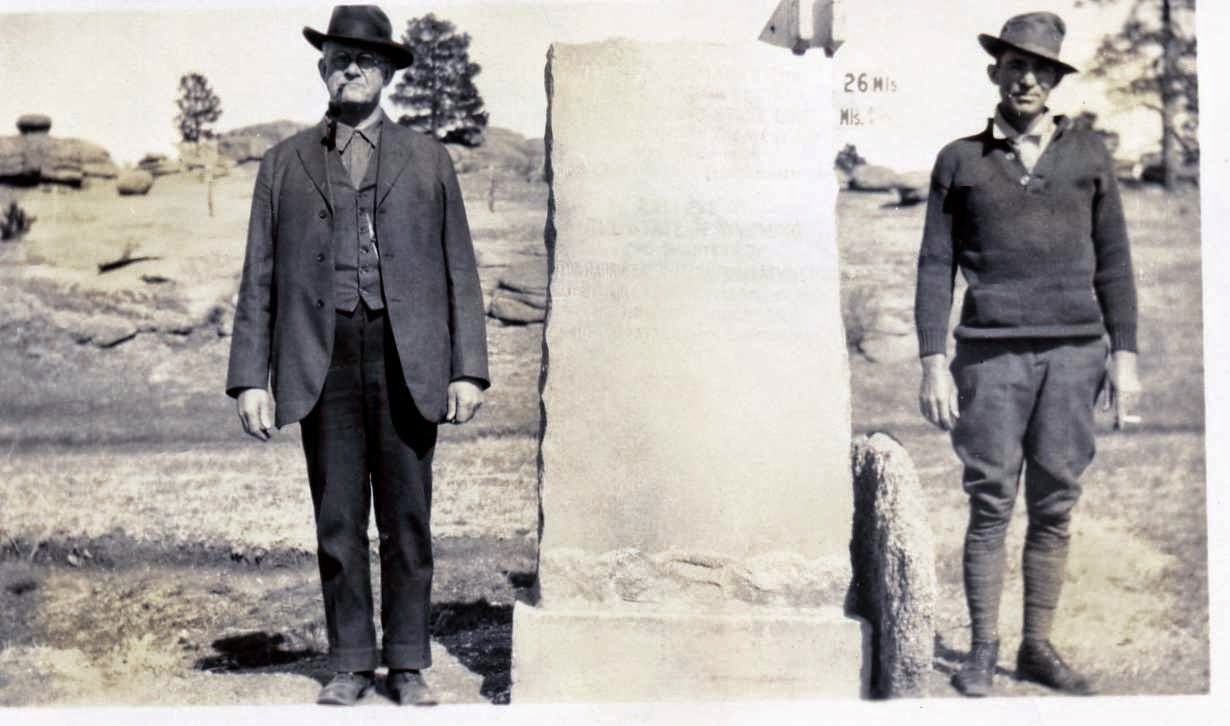
William Eickelberg - left
It would appear that William Eickelberg had the favor of the “common man” in this episode of his life. A few months after this affair, he would pen an impassioned letter to the newspaper urging his, “fellow miners and laborers the necessity of united action on Nov. 6th.” He is asking them to be sure and vote for the Populist Party. Governor Waite had been elected from this party in 1893 and the governor appears to have been a supporter of unions as well as women’s suffrage.

 How interesting to find out that great-great-grandpa was a rabble-rouser!

Wednesday, August 20, 2014

52 Ancestors in 52 Weeks #24 ~ Barbara Zaugg

Written for Amy Johnson Crow's Challenge 52 Ancestors in 52 Weeks. (click on the icon in the sidebar for details at Amy's blog) 

And now we come to the last child of Jacob Zaugg and Anna Stetler as listed in the Zaugg book.


First just the facts:

Name: (Anna) Barbara Zaugg

Born: 07 May 1843, Eggiwil, Bern, Switzerland

Married: 03 Jan 1867 to David Shifferly, Wayne County, Ohio

Died:22 Feb 1914, Wayne County, Ohio [Find A Grave memorial]


Barbara and David will have 10 children as listed in the Zaugg book.  I have been able to find 10 children thoughout the various census records and Wayne County birth records although I have to admit that they tend to have wildly varying names.  In the 1900 census Barbara is listed as having given birth to 10 children and having 10 now living.  The family is really fairly straight forward and I can easily find Barbara and her husband in every census that I should always living and farming in Wayne County, Ohio.  It's just that with 10 children this would be another black hole of research on a collateral line and I'm not going to go there. (and I really need to write that on the blackboard 100 times.)

At this point I'll just close with Barbara's death certificate.  And finally, here is a child who get the names of his mother's parents correct in spite of the fact that his grandfather died before he was born and his grandmother died when he was about four.  Much better than several of his older cousins were able to do for their Zaugg parents.


52 Ancestors in 52 Weeks #23 ~ Peter Zaugg

Written for Amy Johnson Crow's Challenge 52 Ancestors in 52 Weeks. (click on the icon in the sidebar for details at Amy's blog)


First just the facts:

Name: Peter Zaugg
Born: 22 Aug 1839, Eggiwil, Bern, Switzerland
Married: 15 Apr 1862 to Mary Catherine Sorgen, Wayne County, Ohio and then to Louise Wable (?) sometime after 1864 possibly in Adams County, Indiana
Died: 25 Apr 1926 Wayne County, Ohio


Here are the few things I know about Peter:
  • He arrived with the rest of his family on 30 May 1853 at Castle Garden. 
  • By 1860 he is living with his parents in Salt Creek Twp, Wayne County, Ohio. 
  • A few years later he marries Mary Catherine Sorgen, also in Wayne County, Ohio.


Here is the theory I currently have about what happens after that:

Shortly after his marriage he moved to Indiana, most probably Adams County, where his oldest sister, Lizzie, and an older brother, Daniel, were already living. Their first child, Mary, is born there and his wife dies shortly thereafter. He then marries a widow (?) named Louise Kohler nee Wable who has three children. At some point prior to 1869, when Aldine/Aline is born, they have return to Ohio. As listed in the 1880 census their children are:  Aline 11, Peter 7, Ida 5, Alfred 3, Albert 1.  The Zaugg book lists another daughter, Louisa.  It's possible she was born between Aline and Peter.

 I believe that Mary, Peter’s first child would have come with them back to Ohio because by 1880 I find a couple that matches the information in the Zaugg book – a Mary and Robert Shanklin. Peter divorces Louise sometime prior to the 1900 census when Peter is living with his brother Frederick. Of interest are several other families listed on the same census pages living close by. They are mostly Zaugg relatives and include the Mary & Robert Shanklin that I believe to be Peter’s daughter and son-in-law. 

Louisa moves back to Indiana with her 3 children from her first marriage as well as the children from her marriage to Peter. In the 1900 census I find her in Adams County with the following Zaugg children: Peter, 22, Ida 20, Alfred 19 and "Alla" (son) 15.  (The ages seem out of whack, but the other children from her first marriage are there as well and line up better.)  I find Peter in the 1910 census living with his sister Barbara and her husband David Shifferly. And finally, I believe he died in 25 Apr 1926 as this death record fits with everything else I know about Peter.


Here are just a few of the problems and/or inconsistencies with this theory.

  • In 1880 Mary’s birthplace is listed as Ohio. However in 1900, 1910 & 1920 it is listed as Indiana. It is possible that her husband provided the information in 1880 and just didn’t know. That would be especially true if Mary lived in Ohio for most of her life. 
  • The census listings for this Mary & Robert Shanklin don’t match any of the children in the Zaugg book. This is not a deal breaker as there are other notable mistakes in the book. However I’ve yet to find a family that is totally wrong. 
  • Mary’s parents are always listed as being from Germany rather than Switzerland. This seems an odd “mistake” to make living in a community that was so filled with Swiss immigrants. My only thought here is that, again, Robert gave the information and I don’t see that he was Swiss or German. Maybe all he knew was that his in-laws spoke German.

This brings me to my issue. Here is yet another black hole of research that is not in my direct line, Peter being my my 3rd great grand uncle. I KNOW I should just back away slowly and then turn and run. However when I look at the theory and the issues there are just so many things I could look for – and most probably find – that would clear up some of the weak parts of the theory.  But I really need to move on - at least for right now.

At this point I’m going to finish with the children in the original family – one more to go – and then go back to my direct ancestor, Jacob. My plan will be to circle back around and work on validating/sourcing/citing/generally cleaning up everything related my direct line from me back to Jacob. I think I will also put together at least a semblance of a research plan for the other children based on what holes I turned up in my blog posts. That way as I’m working on my direct line if I’m trawling through say Wayne County marriage records I can quickly see if there are others I need and grab them while I’m at it.

That's my story and I'm sticking to it!  (until I spot that first shiny object on Ancestry...)